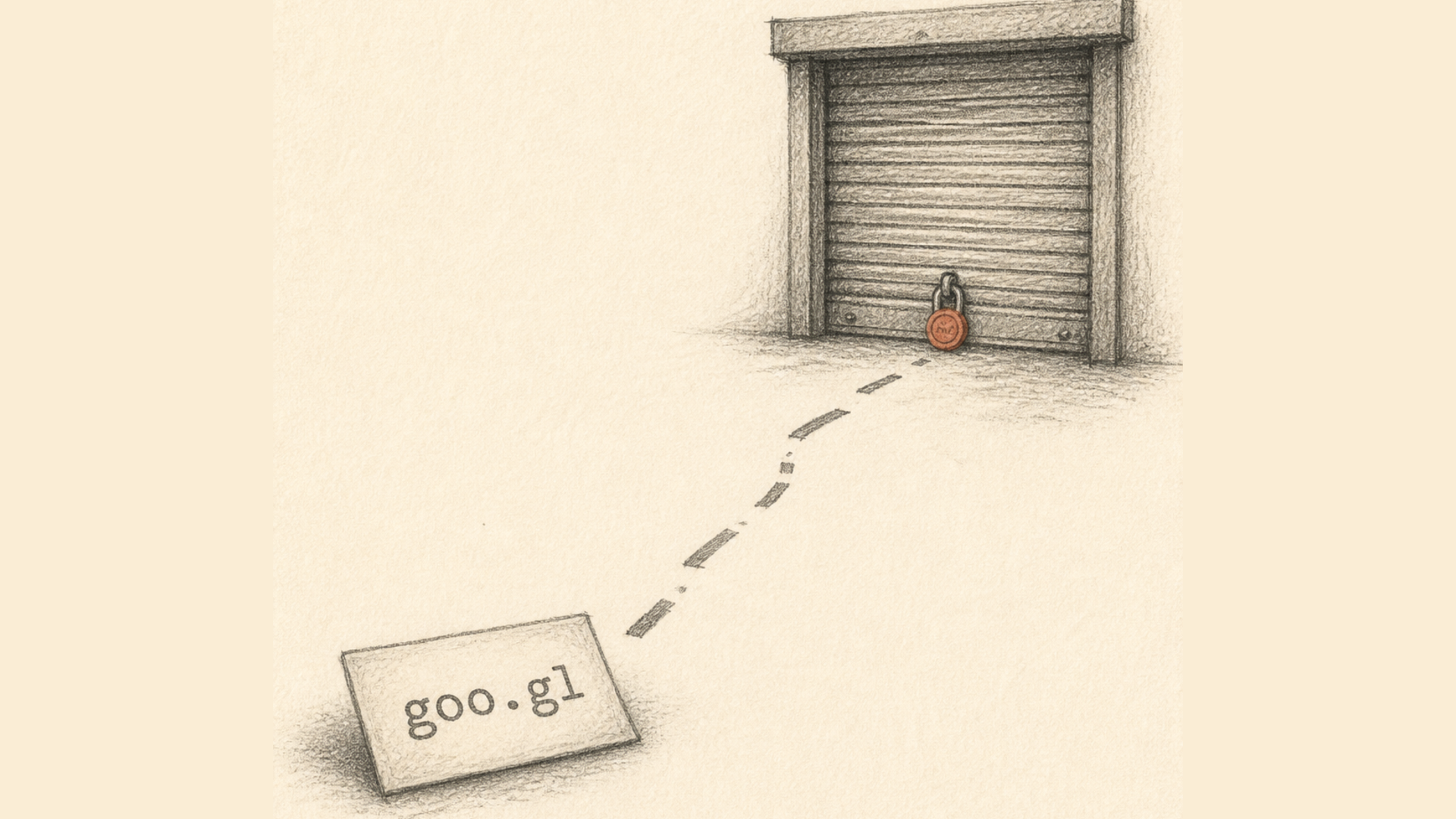
A short link is treated as a consumable. Launch the campaign, collect traffic for a couple of days, forget it. That assumption underpins how results get measured, how print runs are planned, and the decision to recycle an old short URL for a new promotion.
We checked the assumption against our own data. It does not hold.
Roughly a third of clicks arrive in the first 24 hours. Almost a fifth arrive more than six months later. The median link keeps receiving traffic for 153 days.
Here is how we measured it and what follows.
Method
You cannot simply take every link: one created last month has had no opportunity to accumulate a long tail, and the average would collapse. So the analysis uses a cohort.
Cohort: links whose first recorded redirect fell between 24 and 18 months ago. Every link in it had at least 18 months to accumulate traffic, so the sample is not truncated on the right.
Size: 5,946,816 links, 144,404,380 redirects across the 18-month observation window.
Click age is measured from the first recorded redirect. Redirect statistics do not carry a creation timestamp, so the first click serves as an approximation. For links that are published and distributed immediately, the difference is negligible.
Filtering: none. No test links were removed, no service links, no automated traffic. These are raw figures.
Link lifespan was calculated separately on a wider sample: 4,347,730 links with at least ten redirects, measuring the gap between first and last click.
The decay curve
| Click age | Redirects | Share | Cumulative |
|---|---|---|---|
| First hour | 22,841,098 | 15.82% | 15.82% |
| 1–24 hours | 23,355,444 | 16.17% | 31.99% |
| 1–7 days | 23,096,479 | 15.99% | 47.99% |
| 7–30 days | 19,234,965 | 13.32% | 61.31% |
| 30–90 days | 15,776,935 | 10.93% | 72.23% |
| 90–180 days | 12,967,197 | 8.98% | 81.21% |
| Over 180 days | 27,132,262 | 18.79% | 100% |
Three things deserve a careful read.
The first day delivers 32%, not 80%. If you judge a campaign by the report waiting for you next morning, you are looking at roughly a third of what it will eventually produce.
The first week does not even cover half — 47.99%. The standard campaign reporting window cuts the result almost exactly down the middle.
The tail past 180 days is not a tail. At 18.79% it is larger than the first hour and larger than any other single bucket except the full first day. That is a fifth of all traffic arriving when nobody remembers the campaign existed.
Note the shape. The first hour, the 1–24 hour window and the 1–7 day window are nearly identical: 15.8%, 16.2%, 16.0%. The first day is not a spike against a flat background. Decay only begins after the first week, and it proceeds slowly.
Lifespan
The second measurement covers 4.35 million links with ten or more redirects. It captures span rather than intensity: the elapsed time between first and last click.
| Percentile | Duration |
|---|---|
| Median | 153 days |
| 75th | 509 days |
| 90th | 919 days |
Half of all links keep receiving clicks for more than five months. A quarter for more than a year and a half. One in ten for two and a half years.
We deliberately omit the 99th percentile. Data is retained for 42 months, and the value runs into that ceiling — it measures the retention policy, not link behaviour.
Span on its own is a weak metric: a link with nine clicks on day one and a single click on day 150 formally lives 150 days. But the decay curve above shows this is not about isolated stragglers — 18.79% of total volume sits beyond the six-month mark. The two measurements corroborate each other.
69% of redirects carry no referrer
A separate cut over the last 12 months: 723,434,375 redirects.
| Source | Redirects | Share |
|---|---|---|
| No referrer | 499,673,000 | 69.07% |
| Social | 174,908,252 | 24.18% |
| Other sites | 41,489,411 | 5.74% |
| Search | 7,363,712 | 1.02% |
The critical point: "no referrer" does not mean "direct traffic". The Referer header disappears for a range of technical reasons, and nearly all of them apply specifically to short links:
- messengers open links in an embedded browser and send no referrer;
- a QR code cannot send one at all — there was no originating web page;
- browsers strip the header by default on
httpstohttptransitions; Referrer-Policyon the source site can remove it entirely;- native apps hand the link to the system handler, bypassing browser context.
The practical conclusion is blunt: attribution for short links is broken by default. Two thirds of traffic arrives with no stated source, and no shortener can fix that, because the header simply is not there. The only thing that works is tagging inside the address itself — UTM parameters. If you split short-link traffic by channel using the referrer, you are splitting 31% of it and filing the rest as direct.
Devices
| Type | Redirects | Share |
|---|---|---|
| Phone | 384,397,161 | 53.13% |
| Desktop | 273,751,126 | 37.84% |
| Unidentified | 64,739,302 | 8.95% |
| TV | 547,968 | 0.08% |
Desktop share is higher than you would expect from links distributed mainly through messengers and social platforms. Tablets do not appear as a separate category: the detector did not classify them, and they are distributed between phones and desktops. Tablet share cannot be derived from this data.
What follows
Judging a campaign after 24 hours means seeing a third of the outcome. If the decision to extend or kill a campaign is taken the next morning, it is taken on 32% of the data. A reasonable evaluation horizon is a week at minimum, and a month for content with a long shelf life.
A printed QR code outlives the campaign. Packaging, signage, business cards and window stickers last for years, and so — as the curve shows — do the clicks. A QR code should point somewhere that still contains something sensible in two years, not a 404 from a decommissioned landing page.
Do not recycle a short link for a new promotion. The temptation is obvious: the old campaign ended, the address is free. The data says it is not free — people are still arriving through it, and they will land somewhere they did not intend. Meanwhile your new campaign inherits someone else's clicks.
A shortener shutting down breaks years of traffic, not yesterday's. When a service goes dark, it takes with it links that would have kept working for years — and you would never have noticed, because you stopped watching them. This is the argument for a custom domain: the addresses stay yours, and changing provider becomes a DNS edit rather than rewriting everything already published.
Measure conversions, not clicks. Since most redirects carry no referrer and clicks are spread across months, the only reliable way to understand return is end-to-end conversion tracking with tagging inside the link.
Limitations
An honest report has to state where it stops working.
This is one service's data. Audience profile, channel mix and link types differ elsewhere. We are not claiming 32% on day one is an industry constant; we are claiming that across 144 million redirects, the two-day-lifespan assumption does not survive contact with the data.
Link age is approximated by the first click. Links created in advance and published weeks later introduce a systematic bias toward understating age. The size of that bias cannot be estimated from this data.
Nothing was filtered. Automated traffic remains in the sample: crawlers, messenger preview fetchers, monitoring. For some links this may visibly affect the shape of the curve, particularly in the first hours when preview fetchers expand the link. We have not separated that share yet.
The tail is cut by retention. Data lives for 42 months. What happens to links beyond that is not visible here — they may well keep working longer.
Span and intensity are different things. A 153-day median says redirects kept arriving, not that there were many of them. Only the decay curve describes intensity.
In short: a short link is not a two-day consumable but an object with a multi-year lifespan that almost nobody monitors once the campaign ends. Technically it is simple — an ordinary HTTP redirect — but the consequences of that simplicity are long. The practical side is covered separately in short links in marketing and short links: pros and cons.