The question goes like this: "I published a short link to my page. Will that page receive the link equity?"
The answer has two parts, and most articles only cover the first.
Part one: the redirect passes equity. That has been settled for years.
Part two: was there any equity to begin with? This is usually where it turns out there was nothing to lose — and the shortener had nothing to do with it.
Redirects do not lose PageRank
On 26 July 2016, Google's Gary Illyes stated that 30x redirects no longer lose PageRank. The statement was widely reported and has not been walked back since — see the write-up in Search Engine Land.
The same holds in Google's documentation on redirects: with a correctly configured redirect, signals pass to the destination URL.
One detail matters: this covers both 301 and 302. The old belief that a permanent redirect passes equity while a temporary one does not went out of date almost a decade ago. Shorteners nearly always use 302 — precisely because the destination may change — and that does not affect equity. The mechanism itself is explained in how URL shorteners work.
So the redirect is not the obstacle. Now the second part.
Was there equity in the first place?
Before anything can travel down the chain, it has to originate on the linking page. And here comes the awkward bit.
Links on social platforms, in comments, on forums and across most user-generated content carry rel="nofollow", rel="ugc" or rel="sponsored". What each attribute means is set out in Google's documentation on qualifying outbound links. The shared meaning: the platform is telling the search engine it does not vouch for this link and is not passing equity through it.
Hence the central point of this article. If you posted a short link on social media, no equity was passed. But not because it was short — because that platform marks up every outbound link that way. The full URL in the same place would have produced exactly the same result: nothing.
The shortener is almost never the reason. The source is.
Where shortening costs you nothing
Since there is no equity in these places to begin with, a short link takes nothing away:
- social posts and stories;
- comments and forums;
- direct messages and chat apps;
- printed QR codes;
- email campaigns;
- offline materials.
Here a short link wins on every other count — readability, measurability, the ability to change the destination — and loses nothing.
Where the full URL is worth using
Places where a link genuinely passes equity:
- an article on someone else's site that mentions you editorially;
- documentation and technical material;
- partner pages and directories;
- press releases on outlets that do not blanket everything with
nofollow; - your own pages.
There is no technical loss here either — the redirect will pass the equity. But three risks appear that a full URL simply does not carry.
Three risks that genuinely exist
Redirect chains. A short link points at another short link, which points at a third. Crawlers follow a limited number of hops, and an over-long chain risks not being followed to the end. One hop is normal; three or four is a problem.
The shortener may shut down. This is not hypothetical: Google switched goo.gl off and a great many links stopped working. Whatever a link was passing disappears along with it. The detail is in the piece on what happened to goo.gl. The risk is not abstract for another reason: the median short link keeps receiving clicks for 153 days, so what breaks is not yesterday's campaign but traffic that would have kept arriving for years.
You do not control the middle link. While the address lives on someone else's domain, its fate depends on their decisions: pricing, policy, blocking.
An open question with no answer
Here we have to be honest.
Many shorteners, this one included, return the header X-Robots-Tag: noindex, nofollow on the redirect. The noindex directive asks that the redirect itself not be indexed — that part is clear. But whether nofollow in that header affects equity passing through the redirect is not publicly documented.
The argument that it does not: nofollow historically applies to links inside an HTML document, and a redirect is an HTTP-level instruction, not a link on a page.
The argument that it might: the directive is literally named nofollow, and a search engine is entitled to read it broadly.
Neither Google's documentation nor public statements from its staff address this specific case. We do not know the answer, and we are not going to pretend otherwise.
The practical conclusion
It does not depend on how the question above resolves, which is what makes it reliable:
If the link exists for SEO, use the full URL. Shortening gains you nothing in that scenario, while adding a chain, a dependency on someone else's service, and an unresolved question.
If the link exists for measurement, readability or the option to change the destination, shorten it without worry. In the overwhelming majority of those places there was no link equity to begin with, so there is nothing to lose.
The two scenarios barely overlap, which usually makes the choice obvious.
Worth adding separately: the more your links sit on your own domain, the less you depend on someone else's decisions. With a custom domain for short links the addresses remain yours, and changing provider becomes a DNS edit rather than rewriting everything already published. You can connect one on the custom domains page.
What this is not about
Two adjacent things that often get confused with this topic.
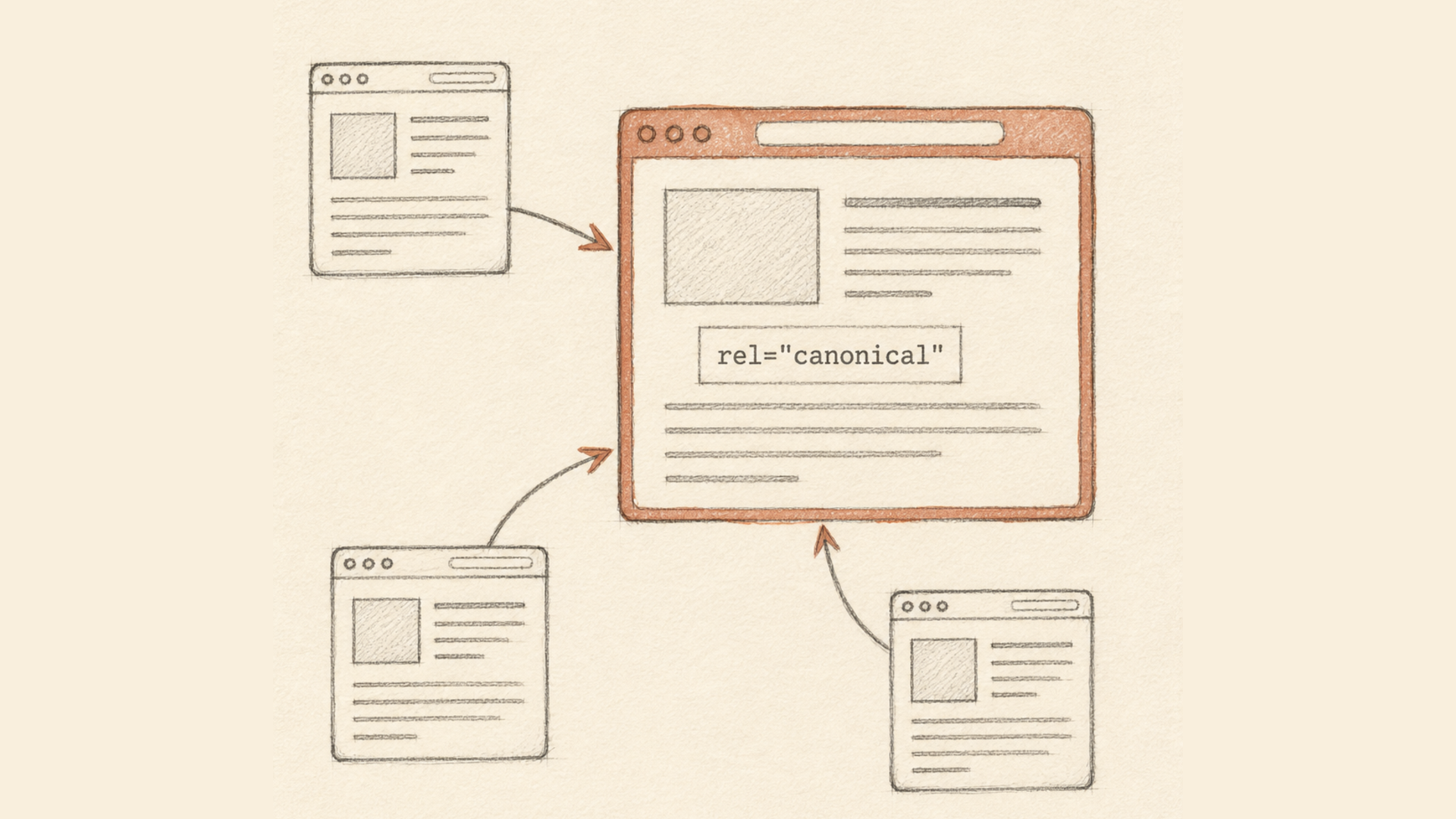
Duplicate pages. A short link does not create a copy — it returns a redirect, which has neither a body nor a <head>. How real duplicates are handled is covered in the guide to rel=canonical.
Indexing the redirect itself. The noindex header on a short link is about keeping the redirect out of search results as a page in its own right. It says nothing about equity reaching the destination.